

Phone Number
+91-859-577-7243 (Sales)
+91-991-063-4466 (Service)

Open Hours
Mon Sat 9:30-19:00

Email Us
sales@optechaircon.com
+91-859-577-7243 (Sales)
+91-991-063-4466 (Service)
Mon Sat 9:30-19:00
sales@optechaircon.com
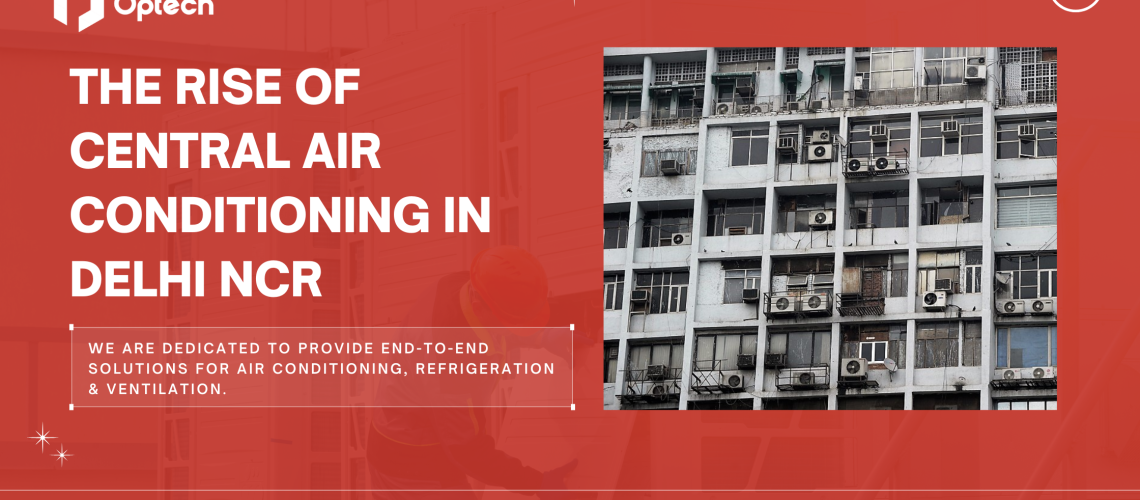
The morning sun breaks through the haze over New Delhi, and by 9 AM, the temperature gauge already reads 42°C. In the sprawling offices of Gurgaon, employees arrive with beads of sweat on their foreheads despite the short walk from air-conditioned cars to lobbies. Children in Noida schools fan themselves with notebooks, while patients in hospital corridors seek any corner that promises a whisper of cool air.
This isn’t just another summer day this is the new reality of Delhi NCR, where temperatures have soared past 50°C in 2024, breaking records and reshaping how 33 million people think about comfort, productivity, and survival. The urban heat island effect has intensified, making the capital 7-10 degrees hotter than surrounding rural areas, creating a pressure cooker environment that demands revolutionary solutions.
Listen closely to the sounds of this transformation: the gentle hum of VRV systems in luxury residences, the whispered conversations in perfectly climate-controlled boardrooms, the silent relief of patients in hospitals where central air conditioning maintains critical temperature standards. This is the sound of Delhi NCR evolving not just surviving the heat, but mastering it.
The statistics are staggering. Delhi recorded 24 nights in May-June 2024 with temperatures above 30°C double the average, creating a scenario where nights offered no respite from the day’s brutal assault. The city’s power demand set new records as air conditioning became not a luxury, but a necessity for survival, productivity, and human dignity.
Walk into any Delhi NCR office building from the 2010s, and you’ll experience the problems firsthand: split AC units struggling to maintain 26°C in conference rooms while electricity bills soar by 300%. Hospitals facing critical moments when inadequate cooling systems fail during surgeries.
Luxury residential projects where individual room ACs create hot and cold zones, leaving master bedrooms comfortable while living areas remain stifling. The emotional weight is palpable sleepless nights, reduced productivity, health concerns, and the growing anxiety about climate change’s relentless advance.
For businesses, the implications were severe. Employee productivity dropped by 15-20% during peak summer months. Hospitals reported increased stress on equipment and patients. High-end residential projects saw customer complaints about uneven cooling and skyrocketing electricity bills. The traditional approach installing multiple split units had reached its breaking point.
Picture the frustrated facility manager of a 200-bed hospital in Gurugram, watching electricity bills climb 400% during summer months while still receiving complaints about inconsistent temperatures in critical care units. Imagine the luxury residential developer in Greater Noida, fielding angry calls from homeowners about their ₹8 lakh worth of split ACs that still can’t cool their 4,000-square-foot homes evenly.
Builders tried cheaper alternatives more split units, industrial coolers, even imported “energy-efficient” models that promised the world but delivered disappointment. Each failed attempt meant more money lost, more customer dissatisfaction, and more sleepless nights for decision-makers who knew their reputations were on the line.
The human cost was real: families considering relocating to avoid Delhi summers, businesses losing top talent to cities with better climate control, hospitals struggling to maintain the sterile, controlled environments necessary for patient safety.
Then came the game-changer that would transform Delhi NCR’s relationship with heat: Variable Refrigerant Volume (VRV) and Central Air Conditioning systems. Like a technological knight arriving just when hope seemed lost, these advanced HVAC solutions didn’t just cool spaces they revolutionized how people experienced comfort.
The numbers tell the transformation story: India’s HVAC market, valued at ₹98,000 crores in 2024, is projected to reach ₹2,20,000 crores by 2030, with Delhi NCR leading this exponential growth. VRV systems offer 30-50% energy savings compared to traditional split AC installations, while providing zone-wise control that eliminates hot and cold spots entirely.
Luxury residential projects in Gurgaon began featuring centralized cooling as a standard amenity
corporate offices reported 25% increases in productivity after VRV installations
Healthcare facilities achieved precise temperature control necessary for critical operations
Educational institutions created comfortable learning environments that improved academic performance
But technology alone wasn’t enough. The real breakthrough came when building developers, hospital administrators, and homeowners realized they needed partners who understood both the technology and the unique challenges of Delhi NCR’s extreme climate.
Today, walking through the corridors of Medanta Hospital or the offices of DLF Cyber City, you experience something remarkable: perfect, whisper-quiet climate control that adapts intelligently to occupancy, weather conditions, and usage patterns. The transformation is profound not just in comfort, but in productivity, health outcomes, and quality of life.
The cultural shift has been equally dramatic. Central air conditioning has become the new status symbol not because of its cost, but because of its intelligence, efficiency, and environmental consciousness. It represents forward-thinking, sustainable luxury that aligns with Delhi NCR’s aspirations as a global city.
In this transformation story, one name consistently emerges as the trusted partner enabling Delhi NCR’s cooling revolution: Optech Aircon Engineers. While technology provides the tools, expertise creates the magic and Optech has been the quiet force behind hundreds of successful central air conditioning installations across the region.
What sets Optech apart isn’t just their technical capability it’s their deep understanding of Delhi NCR’s unique challenges:
Climate Expertise: Having worked through Delhi’s record-breaking summers, Optech engineers design systems that perform reliably even when temperatures hit 52°C. Their load calculations factor in the urban heat island effect, ensuring systems aren’t just adequate but future-ready.
Project Portfolio: From the cooling systems in leading hospitals ensuring patient safety to VRV installations in luxury residences providing whisper-quiet comfort, Optech’s fingerprints are on projects that have redefined comfort standards across Delhi NCR.
Energy Intelligence: In a region where electricity costs can make or break operational budgets, Optech’s designs consistently deliver 30-50% energy savings through optimized system selection, proper sizing, and intelligent controls integration.
Reliability Focus: Understanding that HVAC failure in Delhi summers isn’t just inconvenience it’s potentially life-threatening Optech builds redundancy and monitoring into every installation, ensuring 99.9% uptime even during peak demand periods.
The company’s approach reflects the evolution of the HVAC industry itself: from product sellers to solution architects, from installers to long-term partners. They don’t just deliver cooling systems; they engineer peace of mind.
Future-Ready Vision: As Delhi NCR continues its rapid urbanization with new commercial complexes, residential townships, and healthcare facilities rising every month Optech positions itself not as a vendor, but as a strategic partner in creating sustainable, comfortable spaces that attract global talent and investment.
As Delhi NCR stands at the threshold of becoming a global megacity, the question isn’t whether central air conditioning will become standard it’s whether you’ll lead this transformation or follow it. The data is compelling, the technology is proven, and the benefits are measurable. But success depends on choosing the right engineering partner.
For architects designing the next generation of commercial and residential spaces, central HVAC isn’t just a building system it’s a competitive advantage that attracts tenants, reduces operational costs, and future-proofs investments.
For builders and developers, offering centralized cooling solutions has become the difference between premium projects and commodity developments. Your customers increasingly expect not just air conditioning, but intelligent climate control that enhances their lifestyle while respecting environmental concerns.
For facility managers and property owners, the choice is clear: continue managing the headaches of multiple split systems with rising energy costs and maintenance nightmares, or transition to centralized solutions that deliver superior comfort at lower operational costs.
The transformation of Delhi NCR’s cooling landscape represents more than technological advancement it symbolizes the region’s emergence as a world-class destination where extreme climate doesn’t compromise quality of life, productivity, or ambition.
If you are an architect, builder, or property owner in Delhi NCR who refuses to compromise on comfort, efficiency, or reliability if you’re ready to partner with engineers who understand that great HVAC systems aren’t just about moving air, but about creating environments where people thrive then it’s time to discover how Optech Aircon Engineers can transform your project into a benchmark of intelligent comfort.
Contact Optech Aircon Engineers today and take the first step toward creating spaces that don’t just beat the heat they redefine what comfort means in one of the world’s most challenging climates. Your clients, your budget, and your reputation will thank you.
The future of comfort in Delhi NCR has arrived. The question is: Will you shape it or simply experience it?
Our services span Sales, Service, AMC, and Consultancy for Residential, Commercial & Industrial sectors.
